In short
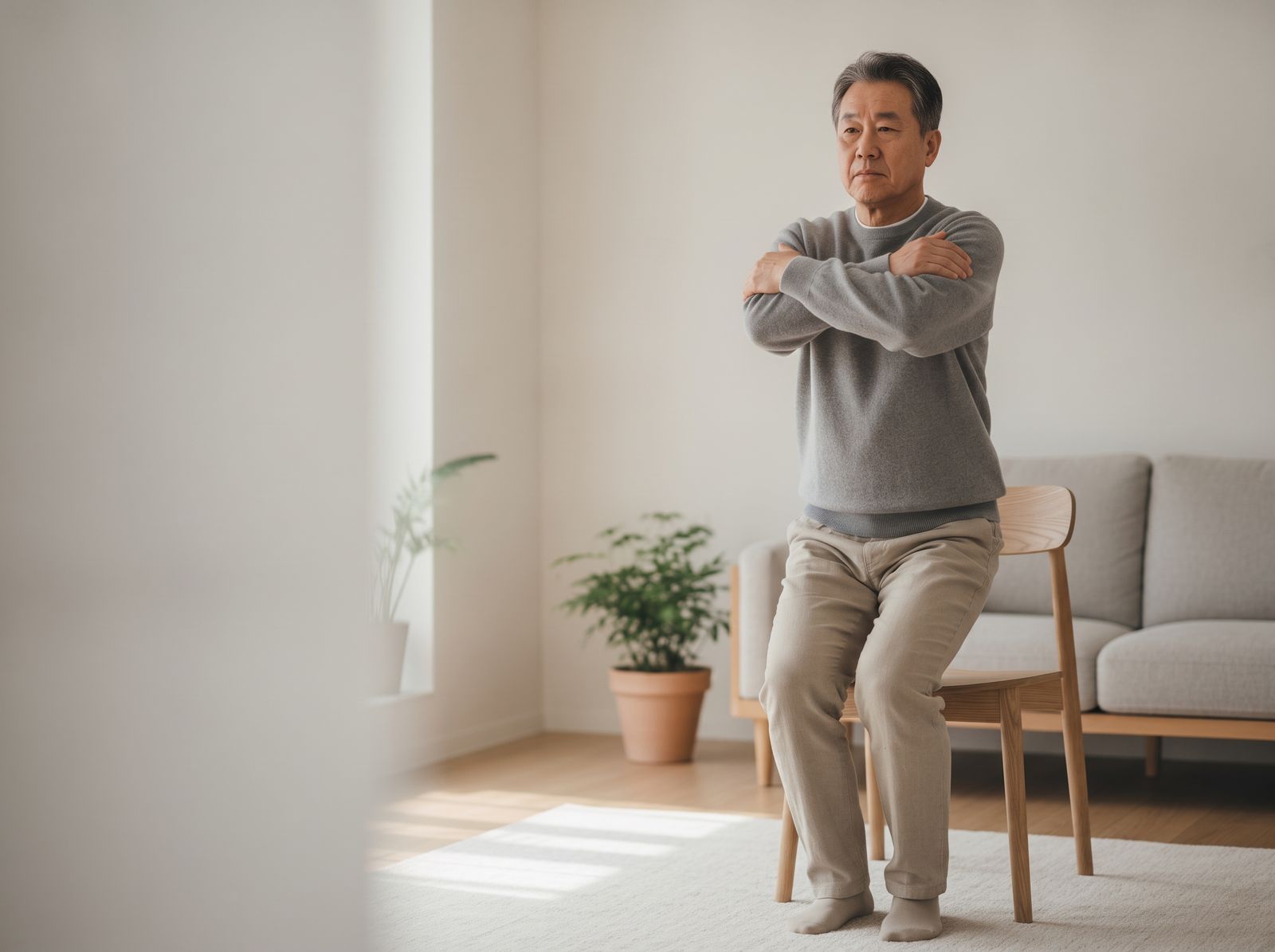
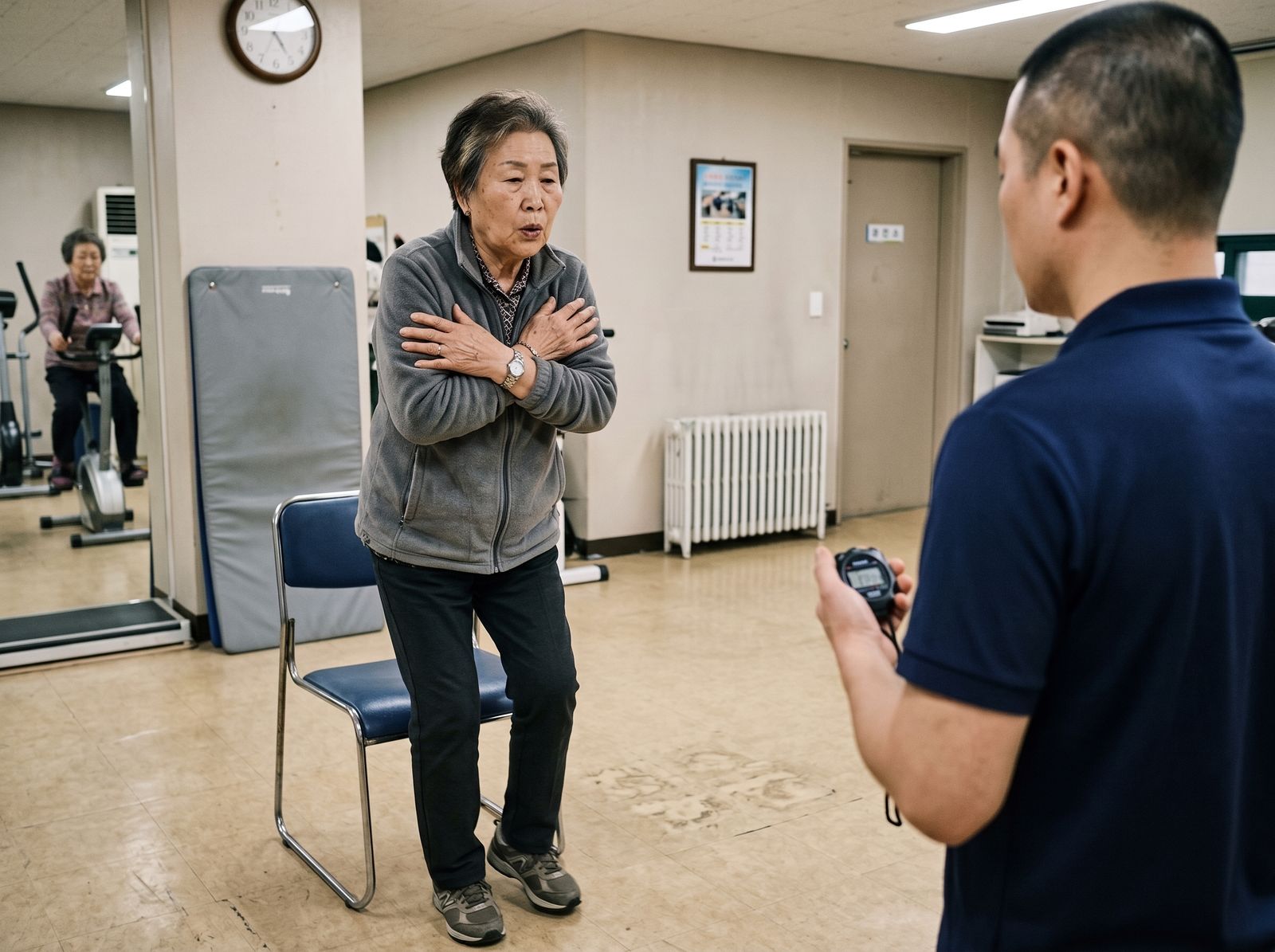
- The 30-second chair stand counts full rises from a chair with arms crossed over the chest. It tracks leg strength reasonably well.
- In a 2026 study of 13,423 Taiwanese adults aged 65 and over, the top fifth on this test had a 45% lower risk of death over about seven years than the bottom fifth.
- Lower scores on the floor sitting-rising test were also linked to higher mortality. All of these are observational studies and do not prove cause and effect.
- If you are at risk of falling or have joint or heart problems, do not test alone, and see a doctor if rising has become noticeably harder.
Three tests, and what they measure
Three rising tests are common in research and clinics. The 30-second chair stand counts how many full rises you make from a chair in 30 seconds with arms crossed over the chest. The five-times chair stand times five rises. The sitting-rising test (SRT) watches you sit down on the floor from standing and get back up; each half scores 5 points, minus 1 for every hand or knee support and 0.5 for unsteadiness, for a total of 0 to 10.
In 1999, US researchers measured the 30-second chair stand alongside maximum leg-press strength in 76 adults with an average age of 70.5. The two correlated fairly strongly (0.78 in men, 0.71 in women), and the number of rises fell from the 60s to the 70s to the 80s. That is why the test is used as a stand-in for lower-body strength.
Rising uses more than leg strength, though. A 2022 analysis of 1,416 people in the Korean Frailty and Aging Cohort found five-times chair stand time was more closely tied to walking speed than to grip strength. Balance, coordination and speed of movement show up as well. The criteria for measuring muscle mass and strength are covered in the article on sarcopenia.
What the studies found about mortality
A nationwide Taiwanese cohort published in JAMA Network Open in 2026 linked standard fitness tests taken in 2015 and 2016 by 13,423 community-dwelling adults aged 65 and over (average 72.9) to national death records. Over a median of seven years, 1,631 (12.2%) died. After adjusting for age, socioeconomic factors, other illnesses and self-reported activity, the top fifth on each test was compared with the bottom fifth.
- 30-second chair stand: 45% lower risk of death (hazard ratio 0.55)
- 8-foot up-and-go: 59% lower (0.41)
- One-leg stance: 50% lower (0.50)
- 2-minute step test: 42% lower (0.58)
- A composite of all seven tests: 61% lower (0.39)
The floor test told a similar story. In 2012 a Brazilian group followed 2,002 people aged 51 to 80 for about 6.3 years and reported that each extra point was linked to 21% better survival. In a follow-up of 4,282 people aged 46 to 75 tracked for about 12 years (published online in 2025), death rates were 3.7% among those scoring a perfect 10 and 42.1% among those scoring 0 to 4. After adjustment, the lowest group had about 3.8 times the risk of death from natural causes and about 6 times the risk of cardiovascular death.
Speed, not just strength: muscle power
Two people may both manage to rise from the same chair, one straight away and the other only after rocking forward a few times. Both have enough strength; they differ in power, the ability to produce force quickly (force times velocity). That speed matters when you catch yourself from a stumble.
A 2025 Brazilian study in Mayo Clinic Proceedings measured both power and strength in 3,889 people aged 46 to 75 and followed them for about 11 years. Those with the lowest weight-adjusted power had about 5.9 times (men) and 6.9 times (women) the risk of death of those with the highest. Strength, measured the same way, showed no statistically clear difference. Power here was measured with an upper-body rowing movement, not a chair stand, but it shows that how fast you can produce force carries its own information.
What these numbers do not mean
- All are observational. The Taiwanese authors themselves say causation cannot be inferred and reverse causation (people already unwell scoring poorly) cannot be excluded.
- Each test was done once; changes over time were not tracked.
- People with dementia, stroke or serious illness and those over 90 were excluded from the Taiwanese study, and the Brazilian participants had no conditions limiting the test. The results do not transfer neatly to frail older adults.
- These are group averages, not a prediction of any one person’s lifespan, and none of these studies tested whether improving a score lowers the risk of death.
Even so, the tests are useful because they need no equipment. Needing your hands more than last year, or wobbling once you are up, is information a bathroom scale will never give you.
Trying it at home, and when to see a doctor
- Use a sturdy chair without armrests, pushed against a wall so it cannot slide, and have someone nearby the first time.
- Stop at once if you feel dizzy, short of breath or chest tightness, or pain in the knees or back.
- Do not try the floor test alone if you are at risk of falling, have had hip or knee surgery, or have severe osteoporosis. The Taiwanese authors also note that clinical use needs safety screening first.
- If you have fallen recently, rising from chairs or stairs has become noticeably harder, or you are losing weight without trying, ask for a proper assessment of strength and balance.
Questions
What is a normal score on the 30-second chair stand?
Norms vary by age and sex, so there is no single number. The studies compared people with others of the same age. Watching whether your count drops year to year, or whether you start needing your hands, is more practical.
If I struggle to sit and rise, will I die sooner?
No. The studies show that groups with lower scores had higher average death rates; they do not predict an individual lifespan. A sudden decline is, however, a reasonable prompt to see a doctor.
Is it safe for older adults to try at home?
Start with the chair version, using a sturdy chair against a wall and someone nearby. After a fall, joint surgery or with heart disease, skip the floor test and talk to a clinician first.
Sources
- Wu MC, Hsu CT, Hsu HT, et al. Physical Fitness and All-Cause Mortality in Older Adults. JAMA Netw Open. 2026
- Brito LB, Ricardo DR, Araújo DS, et al. Ability to sit and rise from the floor as a predictor of all-cause mortality. Eur J Prev Cardiol. 2014
- Araújo CGS, de Souza e Silva CG, Myers J, et al. Sitting-rising test scores predict natural and cardiovascular causes of deaths in middle-aged and older men and women. Eur J Prev Cardiol. 2026
- Araújo CGS, Kunutsor SK, Eijsvogels TMH, et al. Muscle Power Versus Strength as a Predictor of Mortality in Middle-Aged and Older Men and Women. Mayo Clin Proc. 2025
- Jones CJ, Rikli RE, Beam WC. A 30-s chair-stand test as a measure of lower body strength in community-residing older adults. Res Q Exerc Sport. 1999
- Ryu JY, Kim M, Kim KS, Kim S, Won CW. Chair stand test as a proxy for physical performance and muscle strength in sarcopenia diagnosis: the Korean frailty and aging cohort study. Aging Clin Exp Res. 2022
Want to know more?
If you’d like to try BAHI Longevity or talk to us, leave your details and we’ll be in touch.