In short
- Ultra-processed foods are the last of the four NOVA groups: products made with ingredients or additives rarely used in a home kitchen.
- A 2024 BMJ umbrella review of observational studies linked higher intake to cardiovascular death, type 2 diabetes, anxiety and depression, among other outcomes. Association is not proof of cause.
- In an inpatient randomised trial, people ate about 500 kcal more per day on an ultra-processed diet.
- Evidence that emulsifiers reshape the gut microbiome comes mainly from mice; human studies are still small.
What counts as ultra-processed
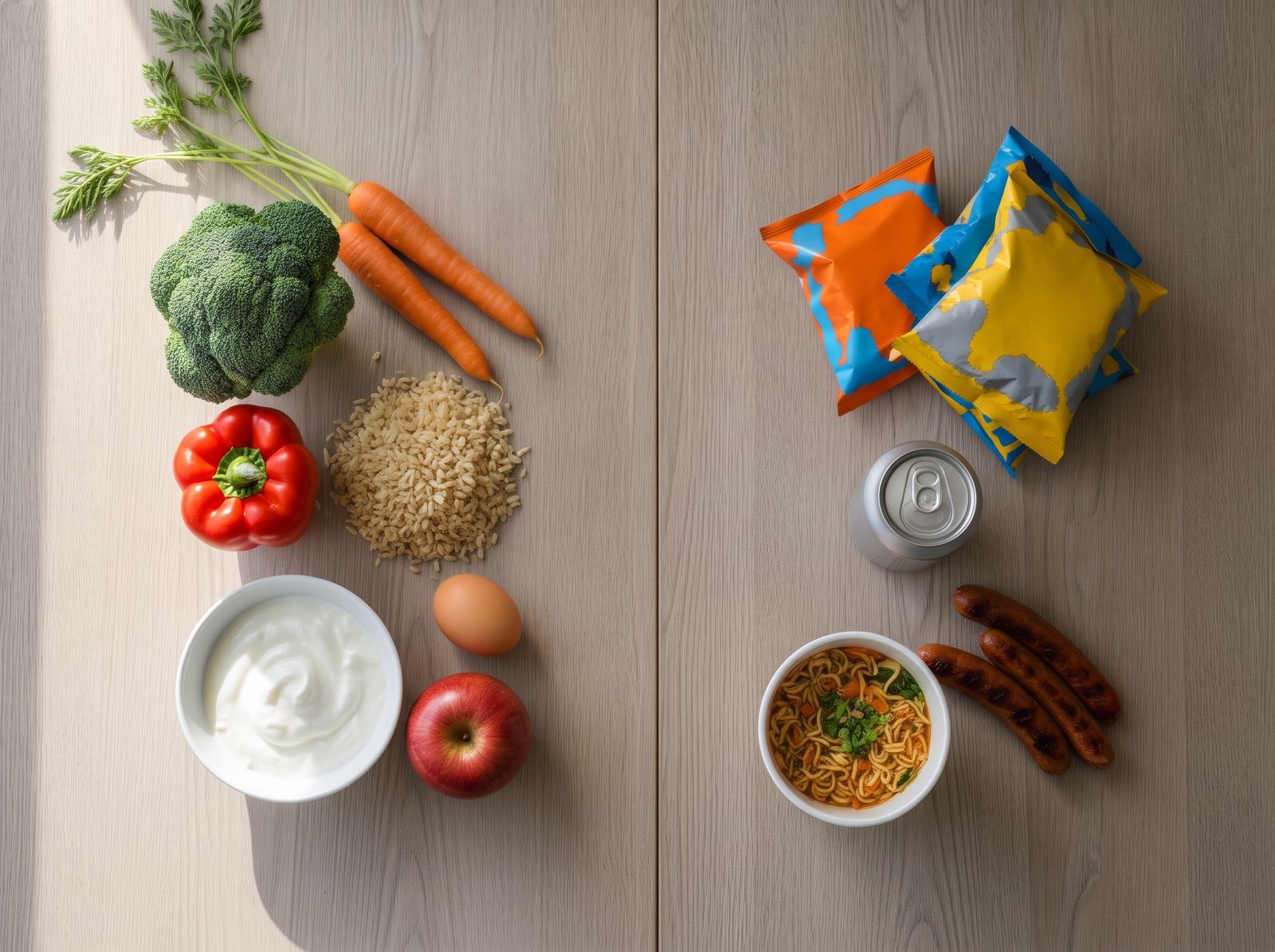
The term comes from the NOVA classification developed by researchers at the University of São Paulo. NOVA sorts foods not by nutrients but by how much, and why, they were processed. Group 1 is unprocessed or minimally processed food such as vegetables, grains and milk; group 2 is culinary ingredients such as oil, salt and sugar; group 3 is processed food made by adding group 2 ingredients to group 1 foods, such as canned foods or cheese; group 4 is ultra-processed food.

The authors’ rule of thumb is simple. If the ingredient list contains at least one item rarely used in kitchens (high-fructose corn syrup, hydrogenated oils, hydrolysed proteins) or an additive meant to make the product more palatable or appealing (flavours, flavour enhancers, colours, emulsifiers, sweeteners, thickeners), it is ultra-processed. Soft drinks, packaged snacks, sausages and other reconstituted meat products, and instant soups and noodles fall here.
What observational studies say about health
A 2024 umbrella review in The BMJ re-examined 45 pooled analyses covering about 9.9 million people. Higher ultra-processed food intake was linked, with “convincing” evidence, to cardiovascular death, type 2 diabetes, anxiety and common mental disorders, and with “highly suggestive” evidence to all-cause death, obesity and sleep problems.
Most of these studies are observational, so it is hard to separate the food itself from the wider lifestyle of people who eat a lot of it. In the same review, the certainty of evidence (GRADE) was mostly rated low or very low.
What a controlled experiment showed
Testing cause needs an experiment. In 2019 the US National Institutes of Health admitted 20 adults to a research ward and gave them an ultra-processed and an unprocessed diet for two weeks each. The diets were matched for calories offered, energy density, sugar, sodium and fibre, and participants ate as much as they liked.
On the ultra-processed diet they ate about 508 kcal more per day and gained about 0.9 kg; on the unprocessed diet they lost about 0.9 kg. Similar nutrition labels did not mean similar intake. The study was small and short, and it did not explain why people ate more.
The gut microbiome and additives
The colon hosts a vast microbial community, and a layer of mucus keeps most bacteria at a distance from the gut lining. Researchers have focused on emulsifiers, which are common in ultra-processed food.
In a 2015 Nature study, mice given relatively low concentrations of carboxymethylcellulose (CMC) or polysorbate-80 showed altered microbial composition, bacteria encroaching into the mucus layer, low-grade inflammation and metabolic changes. Germ-free mice and faecal transplants indicated that the changes ran through the microbes.
In humans, a 2022 controlled-feeding study gave 16 healthy adults a set diet for 11 days. The seven who received 15 g of CMC a day had slightly more abdominal discomfort after meals, lower microbial diversity and fewer short-chain fatty acids. The sample is tiny and the dose may not match everyday intake, so it cannot show that the same happens with ordinary diets.
What is still unknown
- Which feature of ultra-processed food (additives, low fibre, eating speed, energy density) drives the health links has not been separated out.
- The path from microbiome changes to human disease rests mostly on animal and association studies.
- Figures often repeated online, such as a “40% drop in microbial diversity”, are frequently hard to trace to a source.
Experiments in the other direction exist too. In a 17-week randomised Stanford study published in 2021, a high fermented-food diet steadily raised microbiome diversity and lowered inflammatory markers, while a high-fibre diet left diversity unchanged. With 18 people per group, it needs confirming in larger trials. Inflammation itself is covered in chronic inflammation.
A rule you can use when shopping
Not every ultra-processed product deserves the same suspicion, but building meals around minimally processed food is consistent with the research so far. Reading the ingredient list for things a kitchen would not use is the simplest method the NOVA authors propose. If digestive symptoms persist or your weight changes without explanation, see a doctor before overhauling your diet.

Questions
What is the difference between processed and ultra-processed food?
Processed food adds salt, oil or sugar to whole foods, as with canned foods or cheese. Ultra-processed food is made with ingredients or additives not used in home cooking, such as flavourings, emulsifiers and sweeteners, and NOVA classifies it separately.
Does ultra-processed food damage the gut microbiome?
That has not been shown in everyday diets. Evidence that some emulsifiers alter gut microbes comes mostly from mice; the main human trial involved 16 people over 11 days.
How can I tell if a food is ultra-processed?
Check the ingredient list. Items such as high-fructose corn syrup, hydrogenated oils or hydrolysed proteins, or additives like flavours, colours, emulsifiers, sweeteners and thickeners, put it in the NOVA ultra-processed group.
Sources
- Monteiro CA, Cannon G, Levy RB, et al. Ultra-processed foods: what they are and how to identify them. Public Health Nutr. 2019
- Lane MM, Gamage E, Du S, et al. Ultra-processed food exposure and adverse health outcomes: umbrella review of epidemiological meta-analyses. BMJ. 2024
- Hall KD, Ayuketah A, Brychta R, et al. Ultra-processed diets cause excess calorie intake and weight gain: an inpatient randomized controlled trial of ad libitum food intake. Cell Metab. 2019
- Chassaing B, Koren O, Goodrich JK, et al. Dietary emulsifiers impact the mouse gut microbiota promoting colitis and metabolic syndrome. Nature. 2015
- Chassaing B, Compher C, Bonhomme B, et al. Randomized controlled-feeding study of dietary emulsifier carboxymethylcellulose reveals detrimental impacts on the gut microbiota and metabolome. Gastroenterology. 2022
- Wastyk HC, Fragiadakis GK, Perelman D, et al. Gut-microbiota-targeted diets modulate human immune status. Cell. 2021
Want to know more?
If you’d like to try BAHI Longevity or talk to us, leave your details and we’ll be in touch.