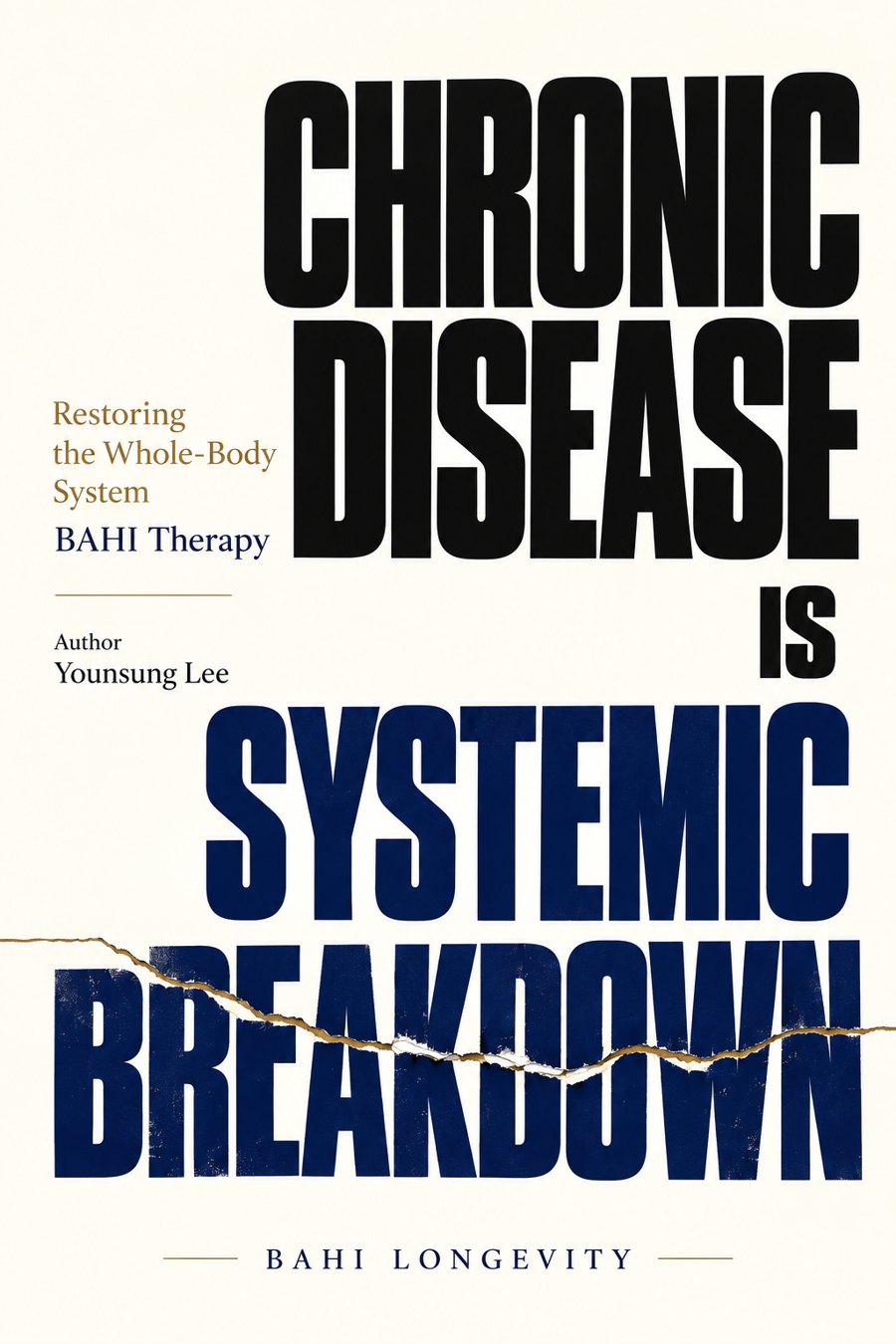
From colon cancer to a long search
Part 1 of the book asks why chronic disease does not go away; Part 2 answers that what breaks down is not one organ but a system of blood flow, hormones and immunity, with metabolism at its centre. Part 3 opens with the next question: how do you rebuild a system that has already broken? The author splits the answer in two. Prevention holds the line through daily habits before the collapse. Restoration works on what has already given way. He insists the two are a pair, not rivals.
Diagnosed with stage 3 colon cancer in 2012, the author began studying medicine to understand his own body. A charcoal kiln sent him into the literature on how light acts on the body and on mitochondria; papers on hydrogen inhalation led him to build a device; his studies brought in hyperbaric oxygen. Combining the three took years.
The book draws a clear line here. This was not a controlled trial but clinical observation, watching people closely over a year and a half in a research setting, and the rigorous testing of mechanisms is still going on. He grouped what the three technologies have in common into four flows, and the name BAHI grew out of that hypothesis.
Why physical restoration?
The question he hears most is simple: why not just eat, sleep and move well? The book grants that this is half right, then answers on three levels. Physiologically, research shows mitochondrial function declines with age, and the author argues that worn microvessels and cellular power plants do not restart on thrift alone. Medically, a drug blocks one signal, while a physical stimulus changes the environment a cell sits in, giving the body’s own homeostasis room to work. Logically, if the cause is the whole system, the approach has to work at that level too.
He is equally firm that this is not an argument against medicine. In heart attacks and serious injuries, emergency care and drugs save lives. What he describes is a division of labour, and he warns that losing that sense turns BAHI into exaggeration. The three arguments point to a broad direction, he writes, not to BAHI as the only answer or a cure for everything.
Build the evidence as rigorously as possible, and say only what that evidence allows.
Three technologies, used together
Why combine them? Because the body is one system. Open a path and harmful reactive oxygen can still damage cells; clear the reactive oxygen and cells still go short if oxygen cannot reach them; deliver oxygen and resting mitochondria still cannot turn it into energy. So whole-body PBM, hydrogen inhalation and hyperbaric oxygen each look after a different junction, with Wave Motion vibration exercise added for circulation.
The book is plain that this combined approach is not a finished answer. Observation and research across several conditions are ongoing, and the honest position is an approach still building its evidence. Chapter 10 walks through the principle behind each technology with references.
Roots in functional and integrative medicine
Functional medicine asks not only "what disease is this?" but "why did this person get it?" Two people can share the same blood sugar reading and arrive there by different roads, one through stress and lost sleep, the other through inactivity and diet. Integrative medicine keeps the precision of modern medicine, its drugs and surgery, and adds evidence-based nutrition, exercise and stress care alongside. The author calls this extension rather than opposition.
Both rest on one idea: healing is something the body does, and doctors, drugs and devices only help set the conditions. The book’s reader Q&A keeps the same line. BAHI does not replace chemotherapy or standard care, the author’s own choice was one person’s experience and not advice, and treatment decisions belong with your own doctor.
Questions this chapter answers
Is BAHI Therapy a treatment?
The book presents BAHI Therapy as a wellness approach under careful observation and ongoing research, not a proven treatment. This page is not medical advice; talk to a doctor about any health concern.
Does BAHI replace chemotherapy or standard care?
No. The book states clearly that BAHI does not replace standard care, and that emergencies and serious illness need modern medical treatment.
The author skipped chemotherapy. Should I?
The book says not to read it that way. It was one person’s choice and experience, not a recommendation, and treatment decisions must be made with your own doctor.
Isn’t a healthy lifestyle enough?
If the system has not yet broken down, the book says prevention through daily habits comes first. Where it has been worn down for years, the author argues prevention and restoration belong together.
See it in 3D on BAHI BODY
Read more on the blog
References from the book
- 로버트 러프킨. 유영훈 옮김. 『내가 의대에서 가르친 거짓말들』. 정말중요한; 2024. (원저: Lufkin R. Lies I Taught in Medical School. Dallas: BenBella Books; 2024.)
- Vatansever F, Hamblin MR. Far infrared radiation (FIR): its biological effects and medical applications. Photonics Lasers Med. 2012;1(4):255-266.
- Short KR, Bigelow ML, Kahl J, Singh R, Coenen-Schimke J, Raghavakaimal S, et al. Decline in skeletal muscle mitochondrial function with aging in humans. Proc Natl Acad Sci U S A. 2005;102(15):5618-5623.
- Ahn AC, Tewari M, Poon CS, Phillips RS. The limits of reductionism in medicine: could systems biology offer an alternative? PLoS Med. 2006;3(6):e208.
- Bland JS. Defining function in the functional medicine model. Integr Med (Encinitas). 2017;16(1):22-25.
- Rakel D. Integrative Medicine. 4th ed. Philadelphia: Elsevier; 2018.