What is happening in the world: beauty, fitness and medicine merge into longevity
The author sees three movements at once. Beauty, fitness, daily habits and medicine are merging; health care is moving out of the clinic and into everyday life through wearables and AI; and the goal is shifting from treating symptoms to extending healthspan. In 2025 L'Oréal partnered with an epigenetic testing company to measure biological age, while hospitals such as Cleveland Clinic and Mayo Clinic expanded into prevention and healthspan programmes. The industry calls 2025 the year longevity went mainstream.
What drives it, he argues, is not a new machine but a new kind of person: patients who read their own data, study their condition and arrive with questions. In Korea, inside a national insurance system, he expects this shift to arrive later than in the US and Europe.
Where BAHI stands today: research in progress
The chapter draws a clear line. BAHI is not a finished treatment. It is an approach whose clinical observation and research are still under way, not yet settled by large randomised controlled trials, and the synergy hypothesis behind combining circulation, antioxidant, hormone and immune care has not been properly tested.
One strand of that research is described: follow-up work on a signal seen in a whole-body PBM pilot study in Parkinson's disease (NCT07271927), through a placebo-controlled animal study and a pragmatic clinical design prepared with university hospitals and day-care centres. In the author's words, everything is still in progress.
A three-month BAHI roadmap
Changing a habit, and keeping it, is the hardest thing in daily life, so the book offers a three-month map instead of a resolution. Month one clears away broken habits, month two rebuilds, month three steadies and measures. Swap seed oils for olive oil or butter and cut sugary drinks, refined carbohydrates and processed food; walk 30 minutes a day, then add light strength work and later flexibility and balance; fix bed and wake times and dim screens at night. Record blood pressure, weight, waist, fasting glucose and sleep, and compare before and after.
The book is explicit that this is one example, not a standard prescription, and that anyone applying it should adjust it with a professional.
Better habits: food, movement, sleep and stress
Food comes down to one swap (stable fats instead of seed oils), one cut (refined carbohydrates and sugary drinks) and one addition (protein, vegetables and fermented food). Two kinds of exercise are enough: walking that leaves you slightly breathless but able to talk, and resistance training, since muscle is the body's largest furnace for blood sugar. Deep sleep is when the brain clears the day's waste. Chronic stress spreads through cortisol into insulin resistance and inflammation, so the book suggests switching tension off once a day, for example with three slow, long breaths.
From patient to agent: the road to BAHI Longevity
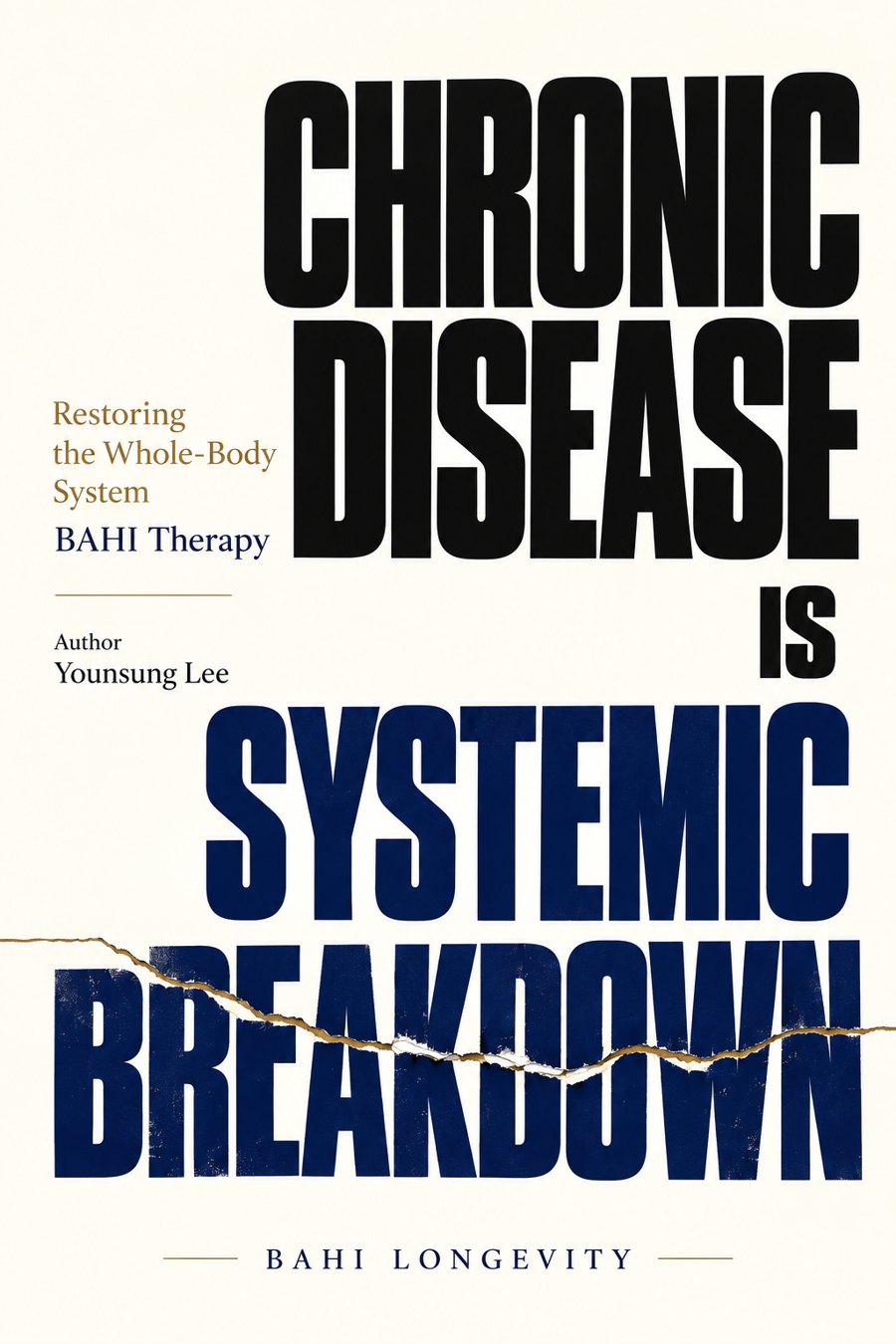
The book closes its argument in three steps: why chronic disease does not heal, what broke (a system and its metabolism), and that restoring it must also be systemic. The author calls the destination BAHI Longevity, not a machine or a procedure but a way of living that joins prevention, restoration and lifelong healthspan design.
He is clear that it does not oppose modern medicine; emergency care still saves lives, and a mature patient keeps both. The first step can be laughably small: a glass of water, a 30-minute walk after dinner, a note of how your body feels tomorrow morning.
Questions this chapter answers
What does longevity mean in this book?
Not a longer life but a longer healthy life. The book describes it as keeping the curve of health flat until near the end, what medicine calls the compression of morbidity.
Is BAHI Therapy a proven treatment?
No. The book describes BAHI as an approach still under clinical observation and research, not settled by large randomised trials. This page summarises the book and is not medical advice; talk to a clinician about any condition.
How is the three-month roadmap structured?
In three phases (lay the foundation, rebuild, steady and measure) across food, movement, sleep and record keeping. The book calls it an example, not a prescription, to be adjusted with a professional.
Where should I start?
If you change only one thing, the book says, change what you eat and drink: less processed food, fewer refined carbohydrates and sugary drinks, more protein and good fats.
See it in 3D on BAHI BODY
Read more on the blog
References from the book
- L'Oréal. L'Oréal announces strategic research partnership with TruDiagnostic to advance beauty and longevity science through epigenomics [Internet]. 2025 [cited 2026 Jul 12]. Available from: https://www.loreal.com/en/press-release/research-and-innovation/strategic-research-partnership-with-tru-diagnostic/
- World Longevity Clinics. When hospital systems host longevity cocktail hours: Cleveland Clinic's prevention push [Internet]. 2026 [cited 2026 Jul 12]. Available from: https://worldlongevityclinics.com/news/cleveland-clinic-longevity-event-hospitals-prevention-push-2026/
- Cosmetics Business. Is longevity the next big beauty category? [Internet]. 2025 [cited 2026 Jul 12]. Available from: https://cosmeticsbusiness.com/is-longevity-the-next-big-beauty-category
- Fries JF. Aging, natural death, and the compression of morbidity. N Engl J Med. 1980;303(3):130-135.
- 저자 연구팀. 특발성 파킨슨병 환자 대상 전신 광생체조절(PBM) 파일럿 임상시험 [Internet]. ClinicalTrials.gov; [cited 2026 Jul 12]. Identifier NCT07271927. (상세 결과는 제11장 참조)